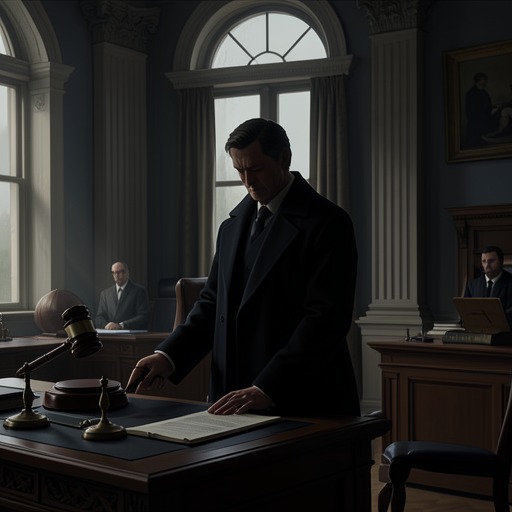
Presumption of Guilt and the Law
Great ExpectationsPresumption of Guilt and the Law is a recurring concern in Great Expectations: the novel sets the legal presumption of innocence against a social world quick to suspect, judge, and punish. Pip first experiences that conflict as a frightened child who imagines punishment before he understands the law; later, a stranger challenges a village’s casual verdict, while Magwitch’s history exposes the unequal weight that class, education, and reputation can carry in court. The result is not a simple opposition between law and injustice, but a sustained examination of how legal language, procedure, and social assumptions interact.
Fear and Suspicion Before Proof
As a child, Pip interprets the fight with the pale young gentleman through fear of what might follow. He imagines that justice may punish him for the encounter and worries that relatives of the young gentleman will retaliate. When he returns to Miss Havisham’s house, no accusation or punishment materializes, yet he conceals the traces of the fight. His anxiety shows guilt taking hold before any official inquiry: imagined consequences become powerful even when no authority has accused him.
Pip’s first response to the attack on his sister follows the same pattern. With his mind full of the story of George Barnwell, he initially suspects that he may have had some part in the crime, or that his obligations to his sister make him a likely object of suspicion. By the next morning, after hearing the circumstances discussed, he revises that fear. The evidence establishes that Joe was away at the Three Jolly Bargemen, that nothing was taken, and that a filed convict’s leg-iron lay beside his sister. The contrast between Pip’s first self-accusation and his later attention to circumstances shows how fear can supply a verdict before facts have been weighed.
The Village Verdict and the Legal Ideal
At the Three Jolly Bargemen, Mr. Wopsle reads an account of a murder and performs the parts of witnesses, accused people, and officials with comic gusto. The company enjoys the performance and reaches a verdict of wilful murder before a stranger intervenes. The stranger asks whether they know that English law supposes every person innocent until guilt is proved. He presses Mr. Wopsle on the difference between evidence and a verdict reached without hearing the accused, then points out that a person who has already judged a case could later be called to serve as a juror in that very trial.
The challenge turns a convivial reading into an ethical confrontation. The stranger’s concern is not only whether Mr. Wopsle has repeated the wording of the law accurately; he asks what it means to condemn someone unheard and then expect to judge impartially under oath. The listeners, who had joined in the verdict, begin to see Mr. Wopsle differently. The scene makes the presumption of innocence a test of conduct, not merely a legal formula: it requires restraint in the face of incomplete knowledge.
Legal Conditions and the Power of Procedure
The law also shapes the terms of Pip’s expectations. Mr. Jaggers tells him that his benefactor’s identity must remain secret and forbids him to make inquiries or suggest a suspected person in their communications. The restriction is presented as a binding condition of the financial arrangement, with the benefactor’s motives expressly left outside Pip’s concern. Here, legal and financial authority governs what Pip may know, while secrecy creates a gap between the appearance of his good fortune and its actual source.
That gap closes when Magwitch reveals himself. He explains that he was sentenced to life-long exile and that returning to England means death if he is caught. Mr. Jaggers later confirms that he had warned Magwitch that he was unlikely to receive a pardon, remained banished for life, and would commit a felony by returning. The prohibition is not an abstract rule: it places Magwitch’s presence in England under the threat of the ultimate penalty and makes concealment and escape central to the characters’ choices.
After Magwitch is captured, procedure determines what can be established and when. At the Police Court, he would ordinarily have been committed for trial, but the authorities need an officer from the prison ship to identify him. The required witness is unavailable, and Compeyson, who had intended to identify Magwitch, is dead. Mr. Jaggers refuses to admit anything on the prisoner’s behalf; he tells Pip that once the witness appears the case will be over quickly and there will be no preventing the conviction. The episode distinguishes the certainty of social recognition from the formal proof the court requires, while showing how the timing and availability of evidence can govern a case.
Compeyson, Magwitch, and Unequal Credibility
Magwitch’s account of his earlier trial with Compeyson gives the novel’s clearest demonstration of class shaping legal outcomes. The two had been committed for felony over the circulation of stolen notes, among other charges. Magwitch recalls that Compeyson proposed separate defences, leaving them without communication, and that Magwitch was so poor he sold nearly all his clothes before he could obtain Mr. Jaggers.
In court, the contrast between the defendants became part of the case against them. Compeyson appeared well brought up, with curly hair, black clothes, and a white pocket handkerchief; Magwitch saw himself presented as the common, poorly educated older offender. The evidence seemed to weigh more heavily on Magwitch: he was more often identified, had received the money, and appeared to have carried out the work and gained the profit. Compeyson, by contrast, was described as younger, educated, seldom seen in the transactions, and merely suspected.
Character evidence and courtroom speech reinforced that division. Compeyson could draw on school connections, clubs, and societies to support his reputation, while Magwitch’s earlier convictions and familiarity to local lockups counted against him. Compeyson’s advocate framed their visible difference as a reason to doubt his guilt and Magwitch’s as a reason to assign him the larger share. Magwitch recalls being able to call Compeyson a rascal but not to match his polished speech. The verdict recommended Compeyson to mercy for good character and bad company, while Magwitch was found guilty and received fourteen years to Compeyson’s seven. The disparity shows how apparently relevant evidence about identity and reputation can be filtered through social rank, making one defendant seem reformable and the other irredeemably culpable.
Evidence, Advocacy, and the Limits of Judgment
Wemmick’s account of Molly’s murder trial offers a contrasting example of advocacy resisting a presumption built from circumstantial evidence. Mr. Jaggers defended her against a charge for which, as Wemmick tells it, there was no reasonable evidence implicating anyone else. The case turned in part on the apparent marks on her hands and on the suspicion that she had destroyed her child. Jaggers argued that the marks could have come from brambles, and that the brambles and traces of her clothing and blood supported that explanation. He also challenged the prosecution’s use of the alleged child’s death to establish jealousy, pointing out that Molly was not being tried for that separate accusation. The jury acquitted her.
The episode places Jaggers’s work beside Wopsle’s premature certainty. In one scene, a crowd casually declares guilt without hearing the accused; in another, counsel contests how physical traces and allegations should be interpreted. Neither episode treats evidence as self-interpreting. Wopsle’s stranger insists on the moral danger of judging too soon, while Jaggers’s defence shows how a lawyer can expose unsupported leaps within a prosecution’s case.
Magwitch’s final sentencing brings the law’s stated grounds and its human consequences into the same scene. The judge presents his history as repeated offending, exile, escape, a period of honest life abroad, and an illegal return. He is described as having been captured while fleeing and as having caused the death of the person who denounced him. Because the prescribed punishment for returning to the country that had exiled him was death, the judge declares that he must prepare to die. Magwitch accepts the sentence, while the court also condemns thirty-two other prisoners. Through that collective spectacle, the novel places individual guilt within an institution whose procedure is formal and public, but whose sentences fall on people already marked by history, reputation, and unequal power.